The Key to Connecting People and Driving Events
The story
Convention Data Services switches to Epson ColorWorks on-demand color label printers to create high-quality tradeshow badges onsite
Organizing and executing a successful conference, exhibit, tradeshow, or industry event requires many months of meticulous planning and careful execution.
Opening day at large events entails tens of thousands of attendees arriving at the venue to complete registration, pick up badges and enter the event.
In an environment with so many people, much anticipation and such great movement, there is enormous pressure to ensure all goes smoothly.
Today, technology and data are the backbone of any event – from planning to registration to post-event analytics. While careful planning and execution are critical to ensure success, any technological hiccup could disrupt an entire event. This is why it is critical that event management organizations invest in and use technology they can rely on.
One vital aspect of any event is attendee badges, which grant access to events, serve as an instant introduction, communicate who a person is and where they work, and can provide actionable data.
According to the Chief Operating Officer (COO) of Convention Data Services (CDS), Dave Wuethrich, “Printing a badge is one of the first steps onsite for attendees, but it is also one of the most crucial aspects of any event as it’s what is used to attract, engage and understand attendees from lead generation through retrospective data.”
He mentions, “A badge is what grants people access and it’s also what drives most of the data. With our system, it is what exhibitors scan to collect data from attendees to build and generate leads and relationships during and after the show.”
Badges, the Backbone of Any Event
CDS, a Freeman Company, is a trusted event registration, business intelligence and lead management partner servicing top show organizers worldwide. The business focuses on registration, lead retrieval and data analytics. While registration provides the data foundation for all of Convention Data Services’ products, it is only the starting point of its comprehensive event management solutions. A badge is a critical component of the services that CDS offers.
As part of its event registration offerings, CDS supplies some of the nation’s largest events with badge printing services. It prints over three million badges annually, with the largest show requiring nearly 130,000 badges.
Most badges, at minimum, have identifiable information, such as name and company, a QR or barcode, and an “explosion” for visual identification – typically in the form of a solid color or icon that identifies someone as a specific type of attendee or from a specific sector of an industry.
“What we have heard over the past few years is that people prefer physical badges to digital badges because it’s easier to identify people for networking and engage in conversations,” said Marketing Communications Manager at CDS, Melissa Nazario.
Building a Next-Generation Technology Suite of Flexible Products
In a review of its badge printing offerings to ensure services are the most effective and streamlined, the CDS team uncovered it would be most beneficial, less time-consuming and more cost-effective to shift to a standardized badge printing process for every event. Previously, they used two different solutions for badge printing – either a color laser printer on blank badge stock, printing the full badge on-demand, or thermal printers in tandem with pre-printed artwork on badges.
“We typically work over 300 events a year and for each event, had to figure out which printers need to be at each show along with the corresponding materials like toner and media,” noted Wuethrich. “Our software would have to duplicate efforts and was inefficient for our logistics team.”
He continued, “Plus, some view a badge as a souvenir – organizations want their badges personalized to include specific artwork or graphics and meet branding requirements. To do this, we used to work with a print shop with a turnaround time of anywhere from two to 12 weeks. This means we would need all assets from organizations well in advance of the event to allow enough time for printing and shipping to the event.”
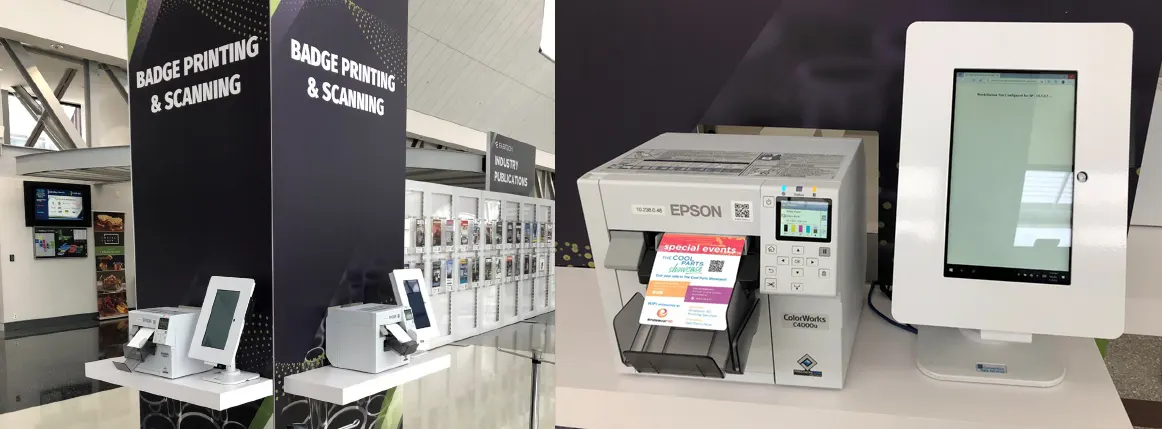
After being introduced to the Epson ColorWorks CW-C4000 on-demand color inkjet label printer, the CDS team decided to evaluate the ColorWorks printer to consider streamlining and standardizing badge printing offerings, increasing efficiencies with logistics and onsite support, and adding flexibility.
In demanding environments where things shift on the fly, organizations demand dynamic label printing solutions to help maximize the mobility and efficiency of operations. The Epson ColorWorks CW-C4000 is a compact, on-demand color label printer designed for businesses that require high-resolution image quality, durable color labels and seamless integration with workflow.
“We don't have an option for a printer not to work,” said Wuethrich. “We won't be in business if our printers do not work onsite, when they are needed, without issue. Reliability is critical.”
In addition to having a reliable onsite printer, print quality and print speed were also important considering factors in the team’s evaluation and validation process. Lastly, the printers needed to be durable and rugged. CDS ships its printers to at least two locations nationwide each month. The printers needed to withstand the not-so-fragile conditions of cross-country freight handling, shipping and exposure.
“The ColorWorks checked all the boxes,” said Wuethrich. “In the validation process and in the field, they have proven to be reliable, can quickly produce high-quality color badges and withstand tough handling conditions.”
Show Floor Success
Wuethrich mentioned that CDS had two specific goals for updating its badge offerings. One was standardization – to have a single badge printing solution that was capable of printing color badges on-demand, while simultaneously simplifying its inventory management, planning and logistics for badge printing equipment and materials.
“Now, all the team must do is allocate the number of printers needed,” said Wuethrich. There’s no more figuring out what type of printer is needed for each event along with allocating and organizing shipping for what type of materials are needed for those specific printers. We have centralized and focused our badge printing.”