ID Card Printing Blog
September 22 2016 |
Are You Ready to Switch to Contactless Cards?
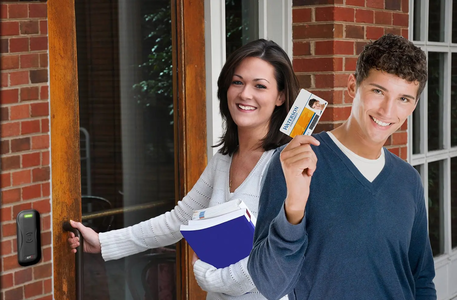
If you are using magnetic stripe data in your ID security card system, there may be many advantages to switching to contactless cards, safety being the primary benefit. Especially for campuses, moving to a contactless card can give you the option of storing volumes of information and making global updates and changes to that information from a central location. In addition to ID cards, contactless technology can be used in keychain fobs, watches, and cell phones.
June 20 2016 |
How to Choose the Right Card for Your Security Needs
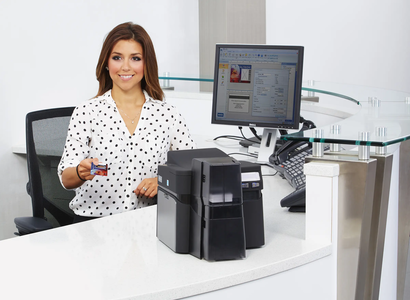
There are as many options for choosing the right ID security card for your business as there are reasons for needing a way to keep employees, visitors, and tenants safe and secure. So how do you determine what the right choice is for all your security needs? We have a quick and easy guide to help you figure out exactly what you need.
December 07 2015 |
Proximity Card Basics
November 18 2015 |
ID Card Security Features Available with Today’s ID Card Printers
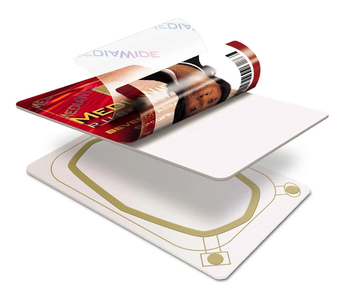
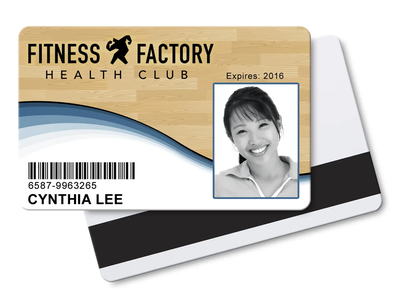
Most businesses and enterprises printing ID Cards are concerned about security at some level. What do we mean when we talk about “ID Card security”? Card issuers primarily want to protect identification, proximity and smart cards from fraudulent use and counterfeiting. ID card security features and technologies are designed to discourage fraud and misuse of ID cards.
When a card is issued the issuer wants to ensure the card is used by the actual person to whom it is issued for the purposes it is issued. Issuers don’t want cards to be used by anyone other than the cardholder, or for unauthorized purposes. The consequences of misuse can be significant and costly. Security features help ensure that the person using the card is the cardholder and that the card is used for an intended purpose. This limits organizational risk and enhances operational and financial control.
July 21 2014 |
Proximity Cards: Best Printing Practices
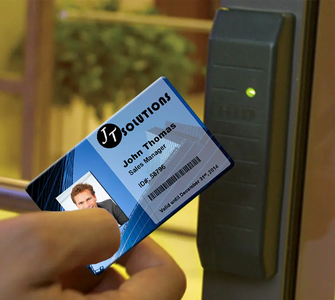
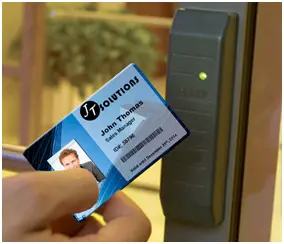
Proximity cards are increasingly popular, and are today’s door-access standard, because they permit users to conveniently (and more quickly) gain entry by simply waving cards in front of a point-of-entry reader. No physical swipe or magnetic strip is necessary. Today these ID cards are offered in open or proprietary formats, and offer varying levels of security, programmed with facility codes and a unique card (user) serial number.
Proximity cards are read-only devices that have an embedded antenna. The cardholder data can be read when the proximity card is passed within range of a reader.
May 07 2014 |
Discover QuickShip, a new way to get your Proximity cards
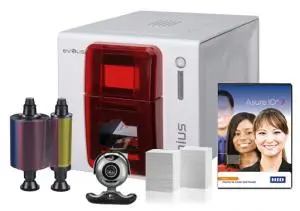
At ID Security Online, we are constantly looking for new solutions to enhance our customers’ experience and help everyone build a successful card program. Today, we are happy to announce the launch of a brand new line of Proximity cards called QuickShip.
Proximity cards have quickly become a premier choice for access control applications. Proximity cards are custom programmed with a facility code and a serial number to control users’ access rights. Proximity cards are widely used in the security industry but are typically ready to ship in 6-10 business days.
December 17 2012 |
Photo ID Cards Help Maintain Security at Construction Sites
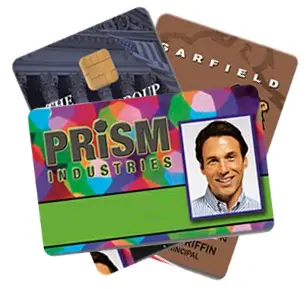
Safety and security at construction sites has never been more important than today. Large and small construction sites have numerous subcontractors on the job site that do not know each other. Expensive equipment and critical supplies are brought in and out of the site on a daily basis. Keeping track of the comings and goings of both people and things are complex and require detail like never before. Job foremen are required to produce more, maintain safety and security and provide more reporting than ever.
October 23 2012 |
Pre-Printed Cards
Are you looking to send a holiday greeting to a friend or a loved one? Is your wedding anniversary around the corner? Do you know anyone who is not well and could use some cheering up? Or are you looking to wish someone a happy birthday? Pre-printed cards provide a quick way to share holiday greetings or birthday wishes, but sometimes the message the card comes with isn't enough. When this is the case, you can deliver your own greeting with the aid of a PC printer and a graphic or word processor program. Printing on the inside of greeting cards requires the same printing process as that used on any heavy card stock. Once you've designed your greeting, simply set the printing parameters and print away, customizing your pre-printed greeting cards to your liking.
August 24 2012 |
Photo ID System and Supplies
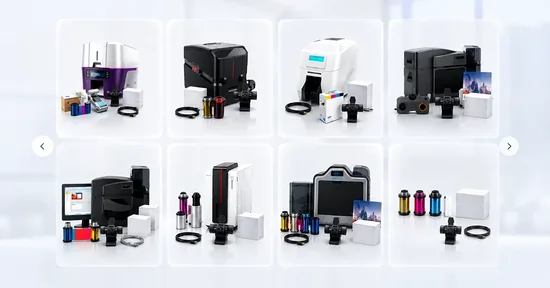
A photo ID system is an integral component of creating an effective ID program. In our modern high tech world, photo ID cards are found far and wide with many different uses. Driver's licenses or passports are no longer the main focus for photo ID. With the sophistication and convenience of a photo ID system, companies are able to easily integrate photo ID into their organizations and enjoy the benefits they have to offer.
August 12 2012 |
Zebra ZXP Series 8 Industries and Applications
This retransfer card printer offers picturesque image quality, best-in-class throughput, a multitude of encoder options, and high reliability that minimizes maintenance. The ZXP Series 8 Printer includes ZMotif™ software development tools for easy integration with enterprise applications. Using innovative retransfer printing technology, the Zebra ZXP Series 8 delivers superior print resolution at the fastest speeds in its class for high-quality photo ID cards with images and graphics that look more like glossy magazine prints than ordinary ID photos. The printer’s modular design provides flexibility to add a variety of encoding options as needed.
Single or dual sided lamination is also available. This retransfer printer is ideal for printing on uneven card surfaces, such as smart cards, or for when the application calls for very high image quality or cards that are more durable and abrasion resistant.
August 05 2012 |
Single and Dual sided ID Cards Printers
Difference between a single-sided ID card printer and a dual-sided ID card printer?
A double sided printer will print on both sides of the ID card whereas a single sided printer will only print on one side of the ID card. A single sided printer is necessary for creating ID cards with limited cardholder information. It has a full color and monochrome printing capability. It offers magnetic stripe and smart card encoding options. You can choose direct-to-card or a stunning reverse transfer print technology. Printing ID cards from a single sided printer can be time consuming. Most card printer manufactures discourage the use of a single sided printer primarily that this printer tends to damage the sensitive print heads in the print cards.
August 05 2012 |
Laminate Photo ID Cards
Why would I need to laminate my photo ID cards?
Firstly, what is a laminated card? A laminated card is a full color plastic card with Matt or Gloss lamination. Matt lamination is a thin coating on a card used to smooth out the printings on the card. This coating provides a soft and silky satin sheen high quality finish resulting in a more sophisticated card. It also allows the card to be more water resistant. It also extends the durability of your card. Gloss lamination forms a protective coating over the print which makes it suitable for items such as menus, cards, brochures etc. Gloss lamination also gives your card a more professional look. These type of plastic cards are used for advertising a business, product, or a service. Lamination serves as a protection for your card. This process is beneficial to the cardholder that it prevents the fading and dye migration via sun exposure on your card. That way, you won't have to reprint your card frequently thus saving you supply costs and time. Holographic lamination increases the security of your cards therefore preventing identity theft or unauthorized duplication of your card. How are laminated cards produced? Multiple cards must be printed on a large sheet. Then they are fed through a laminating unit which provides a thin sheet of laminate either on both or one side of the card. This procedure traps the card in between. Heat is then applied to seal the lamination.
May 30 2012 |
ID card systems reduce school clutter
One of the keys to smooth running in a school is getting students into the building and to their classes in an easy, quick and if possible, comfortable manner. Add in hallway traffic congestion and social chattering factors and you quickly be left with traffic jams. The good news is that the merger of ID card systems and system software can easily reduce hallway, lunchroom and library clutter.
For example, various process take place in a typical school on any given day, such as signing for lunch programs and purchasing lunches, checking out library books, attending schooling events and other annual events, such as buying year books.
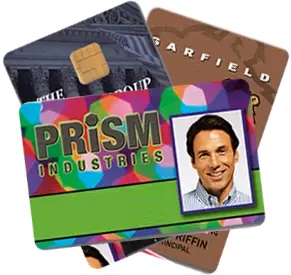
Integrating ID card systems with good ID card software programs is an optimal way to streamline school-related processes and to ensure reduced stress and increased student body flow. By issuing student ID cards laden with embedded mag-stripe encoding or barcodes, students can easily pass their cards through a scanner when signing up for lunch programs, purchasing food or checking out library books.
Aside from moving along these processes in a more efficient manner, students will potentially appreciate the efficiency of being able to wear their ID’s - making it harder to lose, and thus safer with regards to identify theft. Such cards can also be used to issue students lower bus fares, a policy adopted by both private and public schools in Baltimore Country and Baltimore City.
May 28 2012 |
Access Control for Schools
While statistics seem to show that the national crime rate
has fortunately dropped in the last few years, other studies, such as the U.S.
Department of Education’s and the U.S. Department of Justice’s 2006 Indicators of School
Crime and Safety study, indicate that violent crime has risen specifically
among children and adolescents.
Such unfortunate incidents require renewed professionalism
and vigilance with regards to school safety and the integration of appropriate
methods. School administration, staff and the parent body should rightfully vie
for technological integration of visitor management and access control systems.
Such systems are typically used for restricting, recording
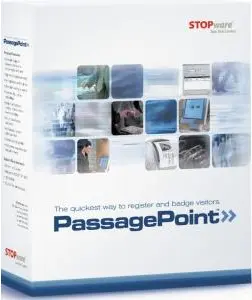
and monitoring access into and departure from a school building. Student-issued ID cards can be synchronized with access control systems, most of which include
or are compatible with software programs, such as the one seen here, designed for tracking visitors,
recording data and compiling it into reports. The main purpose of the hybrid
between existing ID card and access control systems is to help school security
and staff to more easily recognize who belongs and doesn’t belong on the school
grounds.
Access Control — Access control can refer to a single
entrance or to multiple entrances into the building. Such systems can be
integrated into as many entrances as necessary.
Visitor Management Software — The school can also use
software systems ideal for compiling detailed reports describing data, such as
visitor frequency, entrance and exit, and most-commonly used entrances. Such data
can help staff identify and learn about any potential problems related to
violence on campus.
Expiring Badges — Expiring badges are visitor badges with a predetermined “lifespan” and are typically issued to guest speakers or other persons for temporary access to the facility. Such badges are generally effective for one day only or a half-day.
May 21 2012 |
Alternative Ways to Use ID Card Printing for Marketing Purposes
A high number of industries and fields utilize plastic card-printing
technology for an equally high number of purposes. Government buildings and
corporations print on plastic ID badges for access control and visitor management, schools use them as
identity cards for their staff and student body, and financial institutions use
them for credit cards.
However, this blog post will cover other, more out-of-the-box
ways that a standard ID card printer can be used for marketing purposes and to
promote your product.
Wide varieties of theme-specific information can be
incorporated onto a wallet-sized card. For example, if you run a construction
company or any business that involves calculating measurement conversions, such
as carpet sales, you can sell cards with unit conversion information printed on
them.  These can come in handy for customers who buy your products and need to
quickly convert units when placing rugs in their homes or workplace. Other
industries that can benefit from unit-conversion cards are bakeries, which
often require quick conversions for recipes.
These can come in handy for customers who buy your products and need to
quickly convert units when placing rugs in their homes or workplace. Other
industries that can benefit from unit-conversion cards are bakeries, which
often require quick conversions for recipes.
Public safety institutions, such as police and fire fighting
stations, hospitals and schools can print cards displaying emergency
information numbers and addresses on the front on back using dual-sided
printers.
And who says that business cards need to be limited to being
printed on paper cards? Plastic ID cards can contain all the information that a
traditional paper business card displays, but are more durable. This can as
well include restaurants with hours of operation, web site address to view a
menu, and phone number for delivery.
Coupons as well can be printed on plastic cards versus the standard
paper, which can be torn. Further, such cards can be programmed to be used
repeatedly.
Thinking outside of the box when it comes to alternative printer uses can help you advance your marketing strategy, and the technology already exists!
November 22 2011 |
How to Use the Evolis ID Card Printer Series for your ID Badge Needs
Evolis is a printer manufacturer that makes printers used in printing ID badges of different types. Some of the different types of cards you can print are standard ID cards, driver’s licenses, bank cards and access badges and the like. A badge typically holds information about its owner, such as name, a photograph and perhaps statistical information such as height, weight and hair color, etc. The purpose of an ID badge is to identify the individual.
PVC Cards
The types of cards used are the standard type of cards used by most printer manufacturers. These cards are known as PVC (yes, the same PVC used for piping), but are more commonly known as plastic cards. Since they are smooth to the touch, PVC Cards require printing via a method known as thermal transfer printing, which uses a printer part known as a ribbon to apply either a colored or monochrome layer. Contrast this with your standard inkjet printers, which place the ink directly on the page. Thermal printing is necessary since the heating process causes the ink to remain glued to the surface, which is not an issue with printing on paper.
When printing in color, the heat turns the ink layer into gas that reverts to its original state on the card’s surface, a process known as sublimation, or dye sublimation. Evolis printers can print in both monochrome and color.
Bar Code Application
Bar codes are perhaps the most basic feature of plastic cards and are used in many places, such as in stores that sell merchandise branded with bar codes. It is therefore not limited only to cards, but to a variety of plastic surfaces that require bar code identification. A bar code works by creating highly distinct black and white areas that are read by a photosensitive electronic scanner. When the card is passed under the light emitted from the scanner, the scanner detects which light is absorbed by the black areas and which is reflected by the white areas, a pattern which registers as a product or item. We’ve all been in line at the grocery store only to find that the cashier has to scan our item over and over again while people behind us are getting impatient. A scanner has a hard time reading a bar code when the lines are not printed sharply or evenly.
Rewritable Printing
Rewritable printing is to printers what rewritable CD’s are to CD burners. Any images printed on a rewritable card can be erased by being exposed to heat (230-320° F or 110-160° C). A typical PVC card can go through this process usually up to 500 times.
Lamination
Printing lamination is similar to the standard form of printing, whereby a material such as paper is covered in a protective plastic sheath. In printing, specifically in ID card printing, lamination is used in order protect card images from destruction, either accidental or deliberate. Such damage renders a card used for identification useless, or worst, if a card with an unrecognizable image is lost and found by somebody else, it can lead to identity theft. Evolis offers cards of this type in order to prevent against the types of forgery associated with damaged cards.
Holograms
It is also possible to apply holographic images to PVC cards. Cards with images are typically used by institutions that seek to avoid counterfeiting and forgery, such as banks or facilities that require an age limit for access. Holographic images cannot be duplicated with a standard Xerox machine, scanner or standard inkjet printer, which is why certain organizations opt to use them.
Magnetic Encoding
Magnetic encoding is a black stripe placed on the back of a card, usually bank cards. The particles in the magnetic encoding stripe hold binary information (1’s and 0’s) that a scanner, or reader, encodes when swiped. Evolis makes magnetic encoders that are able to create the magnetic stripes used by financial institutions.
Contact Cards or Smart Cards
Contact cards, also known as Smart Cards, are plastic cards fitted in an internal chip that can hold more than 100 times the amount of data that a magnetic stripe can hold. They are swiped much like a magnetic encoding card and also rewritable.
Contactless Cards
A contactless card is a card that holds information read through the transfer of microwave frequencies from a chip to the laminated plastic card. This mechanization means that the card doesn’t need to be swiped, but just passed nearby the scanning device (between 3-10 cm) and allows for quicker and more efficient access. Contactless cards can be used for a variety of applications, depending on the card model, and is common for access security, data storage and encryption.
September 20 2011 |
The Different Types of ID Cards
The purpose of this post is to inform the reader of the various types of ID cards that exist out there in the printing world. My hope is to present a brief, but high quality, catalogue of the different ID cards as well as an explanation of what the cards are typically used for. Many of the types of cards explained here in overlap to some degree. For example, one type of card might be a general category of card, while several others are types of that card that belong in that general category.
Proximity Cards
You’ve probably heard this term a whole lot, but don’t know exactly what it is. The term refers to an integrated circuit apparatus used for a variety of basic uses such as security access control and payment systems. The two main types of proximity cards come in the 125 kHz devices or the newer 13.56 MHz variety. These cards are often referred to as RFID cards, or Radio-frequency Identification Cards, but are also known by the term “contactless smartcards.”
Access Control
An Access Control card is designed to grant access to an enclosed area, be it a business office, airport, or government-type organization. Access Control is a general category, and access control cards can take the form of proximity cards and come with the option of displaying a photo of the card holder. Access control cards typically contain magnetic chips that grant the user access.
Clamshell Card
A Clamshell Card is a protective covering used to house a contactless smartcard.
Flexpass Imageable Cards
Flexpass Imageable cards are particularly useful for barcode transactions or those which require magnetic stripes and a dye-sublimation printer can be used to print digital images and graphics onto their surface.
Embeddable Cards
An embeddable card, sometimes also known as embedded cards, is an RFID card embedded with a chip. The card can be used for access control, purchases and cash withdrawal and this type of card has been in use for several years.
Hologram card
An ID card with a built-in hologram, an added security measure from counterfeiting.
iClass Key
The “key” in iClass Key refers to a small contactless smartcard placed in an also-small plastic knob. It serves the same purpose as most access proximity cards as long as the function does not require you to present a photo ID. Some of the plusses of this technology is that it protects your card from the elements and can be easily carried on a key chain or some similar accessory.
iClass Tag
The “tag” in iClass Tag is a contactless smartcard device roughly the size of a coin and is a transponder that you can attach to a non-metallic surface.
ISO/IEC 14443
The international standard that defines ID proximity cards and its communications transmission protocols.
Mifare Card
A patented contactless smart card standard corresponding to ISO 14443.
SDK (Software Development Kit)
An SDK is a software development kit that is used to create applications for software packages and other platforms.
Wiegand Cards
A Wiegand card utilizes embedded ferromagnetic wires, ferromagnetism being the mechanism that causes materials to be permanently magnetized, even after the energy field is removed. These wires are turned away in a strategic fashion as to generate the user’s individual ID number.
Contact
us at IDSecurityOnline today at
(800) 897 7024.


- 37 West 26th St 10th Floor New York, NY 10010 U.S.A.
- sales@idsecurityonline.com
- 800-897-7024
- 1 (888) 239 4912
2009-2026 © IDSecurityonline.com. All rights reserved.